PROVE IT
Book Preview
INTRODUCTION
On May 19, 2026, it was announced that Schlitz Beer would no longer be brewed.
This is relevant because 119 years ago, the “Godfather of Advertising,” Claude Hopkins, demonstrated the power of proof-based marketing that took Schlitz Beer from dead last in sales to number one. And it stayed number one for decades.
Here’s what happened and why it matters to Senior Living.
In 1907 “PURE” was the buzzword and breweries bought full-page ads to shout “PURE” louder thaneveryone else. Little was said about taste, craft, or process.
To save Schlitz, Hopkins knew he needed to uncover what “pure” actually meant.
During his tour of the Schlitz brewery, he was amazed to learn the beer’s water came from artesianwells 4,000 feet deep, he saw plate glass rooms of filtered air where the beer cooled over pipes that were cleaned every day, costly white wood-pulp filters, enamel tanks, and steam sterilized bottles. All of this ensured Schlitz was free from impurities. That it was PURE.
Hopkins was astonished by this and asked why Schlitz had never told the public any of this?
“Everybody makes beer this way,” they said. To Schlitz, it was just how beer was brewed. That’s acritical point to remember.
Hopkins realized customers didn’t know any of this. While “purity” had become meaningless noise,details like filtered air, artesian wells, and enamel tanks, felt fresh, specific, and compelling.
Ignoring the status quo, Hopkins created a campaign around HOW Schlitz was brewed, even thoughthat process was not unique. The ads talked about the artesian well, the filtered air, the sterilization of the bottles, and enamel tanks.
Competitors screamed they did all these things, but it was too late.
Schlitz rose to number one in American beer sales and enjoyed decades of success.
As Hopkins later explained:
“The maker is too close to his own product. He sees in his methods only the ordinary… They weresimply the first to tell convincing facts.”
Schlitz didn’t win by inventing a new process. They won by being the first to explain it well.
You can see the ads on https://seniorlivingproof.com/schlitz
The lesson:
What feels ordinary to a community is compelling to the Gen X decision maker. As PROVE IT!reveals, concrete and meaningful details are what Gen X needs in order to trust your community.
In 1907, “purity” had become meaningless noise in beer marketing. Compare that to the senior living language of 2026:
- Care With Dignity
- Where Care Meets Comfort
- Compassionate Care
- Supportive
- Welcome Home
- Engaging
- Vibrant Living
- Empowering Your Way Of Life
- Nurturing
- Enriching
These claims provide no substance upon which Gen X can make an educated decision. And becausethey’re over-used, they have little impact.
Like Hopkins, you’ve got to differentiate your communities by looking beyond convention andreveal what’s hidden.
As you know, the Gen X decision maker thinks and behaves differently
than their Boomer parents when they were making this decision.
Instead of talking about what you provide, you need to prove how you provide it.
That transparency is contrary to “the way everyone does it,” but will give you ownership of a newcategory in your market.
Will competitors eventually catch on? Maybe. But the owner of a category is rarely unseated.
As Hopkins said: “Schlitz didn’t win by inventing a new process.
They won by being the first to explain it well.”
Part One: The Buyer Who Changed Everything
That Boomer decision maker has retired from that role and they are entering Assisted Living andMemory Care.
Part One is about who replaced her, and why that requires more than a messaging refresh or awebsite update.
Chapter 1 is about the Boomer buyer your marketing is probably built for: what she needed, why itworked, and why the model has expired.
Chapter 2 is about the Gen X buyer, who she is, what formed her, and what she will do before calling.
CHAPTER 1
How Boomers Made This Decision (And Why It Worked)
The marketing playbook that filled communities wasn’t wrong. It was exactly right for the Boomerbuyer it was built for. The buyer has changed.
But before you can understand what Gen X needs from you now, you need to understand what Boomersneeded then, and why delivering it was so much simpler.
The contrast isn’t history. It’s the lesson.
The World Boomers Grew Up In
Boomers extended trust to institutions. That wasn’t naïve. It was learned behavior, earned over alifetime of systems that delivered.
Their childhoods were shaped by the post-war expansion of American hospitals, churches, corporations, and government programs that worked. The trust wasn’t blind; it was built on evidence accumulatedacross decades of ordinary life.
That posture carried forward. When a Boomer evaluated a senior living community, the default wasopenness. “Show me what you have” was a genuine invitation, not a test.
That’s a significant difference from Gen X.
The Pain Point Was the Nursing Home
Senior living marketing in the Boomer era was organized around a single, powerful contrast: we arenot the nursing home.
The institutional care their grandparents received was sterile, clinical, and depersonalizing. Familiesknew it. They feared it. The newer hospitality model with its beautiful dining rooms, activity calendars, and warm residential spaces that didn’t look like a ward, was the direct relief from that fear.
The message was straightforward: your mother will live here, not recover here. It landed because itsolved the exact problem the Boomer buyer feared.
That contrast between living options was real and the marketing built on it was effective.
Inside-Out Marketing: “Here’s What We Have”
The Boomer model was built inside-out. The community was the subject. The community decidedwhat to show, what to emphasize, how to frame itself. The prospect was the audience.
“Here’s our beautiful salon. Here’s our activity calendar. Here’s our caring staff.” The Boomer buyerlooked at that presentation and said: I trust this. I can see mom here.
That sequence worked because the Boomer decision maker was willing to extend trust before theevidence was examined.
The primary marketing assets were the website and brochure. They were polished and built to impress.The central sales skill was personal connection, delivering the emotional promise of relief from guilt and from the clinical alternative. Warmth, aesthetics, and a skilled relationship-builder were oftenenough to move the decision forward.
And it worked. For years, it worked.
Why It Has Expired
The adult child researching communities for a parent today is Gen
- She doesn’t extend trust. She tests for it.
And she arrived at this decision already skeptical — not because any specific community gave her reason,but because 40 years of formative experience taught her that institutions say one thing and do another. She is not going to set that conditioning aside because your homepage has warm photography and atagline about compassionate care.
The beautiful brochure doesn’t impress her. The warm sales counselor doesn’t reassure her. The lifestylephotography of happy residents in a sunlit dining room doesn’t answer her question: what happens to my father on a Thursday night when something goes wrong and I’m three states away?
The Boomer model ran on trust extended in advance. Gen X doesn’t extend anything. She makes youearn it.
That’s not a messaging problem. It isn’t a design problem. It isn’t a matter of refreshing thewebsite copy or swapping in newer photography. It’s a fundamental shift in who is making thedecision and what they require to make it.
This book is about that difference.
NOTE: Like all chapters in this book, Chapter 1 concludes with a prompt yo can use to accomplish the teask outlined by the tet. I have omitted it in this preview.
CHAPTER 2
Meet the New Decision-Maker
She has already read your Google reviews. Researched your most recent state inspection report andfound a Reddit thread from a family who toured you eight months ago.
She hasn’t called yet.
Who She Is
Gen X was born between 1965 and 1980. In 2026, that puts her between 46 and 61. She is at peakcaregiving age, peak career pressure, and for most, peak financial strain.
She is simultaneously raising children who may still be at home, managing her own emerging health concerns, and carrying the logistical and emotional weight of a parent who can no longer manage alone. The Mather Institute calls it sandwich generation stress. The American Society on Agingdescribes it as “identity fragmentation under caregiving pressure. “She’s not just overwhelmed. She isbeing asked to be three things at once, and they all need her attention.
She is your primary customer. And she requires a fundamentally different approach than anything your current marketing was built to deliver.
How She Got Here
To understand Gen X as a decision-maker, you have to understand what built her.
She grew up in an unstable world. Divorce rates peaked during her childhood. Many householdsneeded two incomes and had only one. The latchkey experience — coming home to an empty house and figuring out dinner — was not exceptional for this generation. It was ordinary. Self-reliance wasn’t a philosophy she adopted. It was asurvival skill she developed before she was old enough to name it.
The institutions that were supposed to be trustworthy kept failing publicly. Watergate was her oldersiblings’ lesson. The Challenger explosion was hers, live on classroom television in 1986. AIDS. Chernobyl. Corporate downsizing. The dot-com crash. The Great Recession. Each one was aconfirmation of the same underlying truth: institutions say one thing and do another, and the people whotrusted them without checking paid the price.
Her core identity phrase is four words: “I’ll figure it out myself.”
That phrase is her operating system. It tells you everything about how she will research your community,what she’ll do with the information you give her, and what she will do when she suspects you’re not telling her everything.
Three Generations at a Glance
Before going deeper on Gen X, it helps to see her in context. The table below compares Gen X to the tworecent cohorts and the dimensions that matter most for senior living.
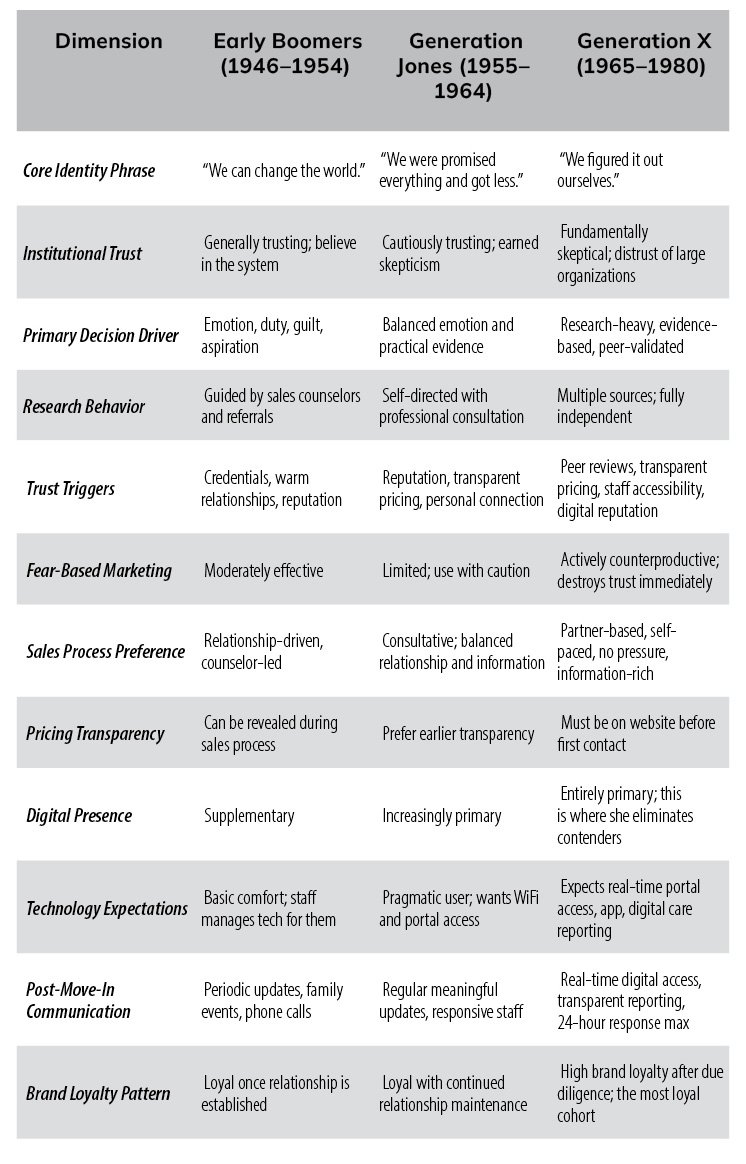
Two things stand out in that table.
First: Gen X sits at the far end of nearly every dimension. She is not a slightly more skeptical GenerationJones buyer. She is a categorically different buyer who requires a categorically different approach.
Second: the brand loyalty row. Once you earn a Gen X family, you earn something durable. Gen X isdescribed as highly brand loyal. A Retail Dive study reported that 70% of U.S. respondents said brand loyalty was highest among Gen X.
The hard work is entirely front-loaded. Get through her vetting process, and she stays.
Her Default Assumption
Before she reads a single word of your website, her default assumption is that you’re not showingeverything.
Not because you have done anything wrong. But because that’s what institutions do. She has 40 years ofevidence. She is not going to set it aside because your homepage has warm stock photography and a tagline about an engaging environment.
This shapes everything. The first job of your marketing is not to build trust. It is to avoid triggeringdisqualification. Trust comes later. Survival comes first.
The community that understands this builds its entire presence around one internal question:what should we show a skeptic who assumes the worst? The community that doesn’t understand thisis running the Boomer playbook on a buyer who won’t respond to it.
The remainder of Chapter 2 is in the book.