Pure Genius
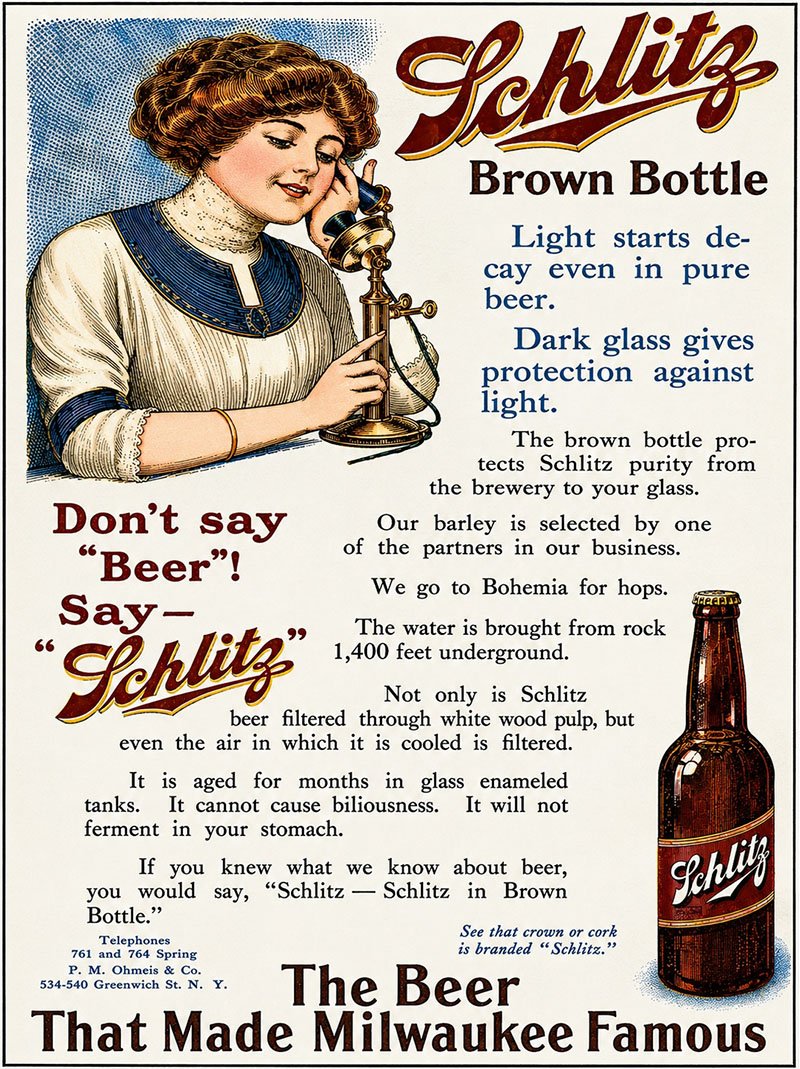
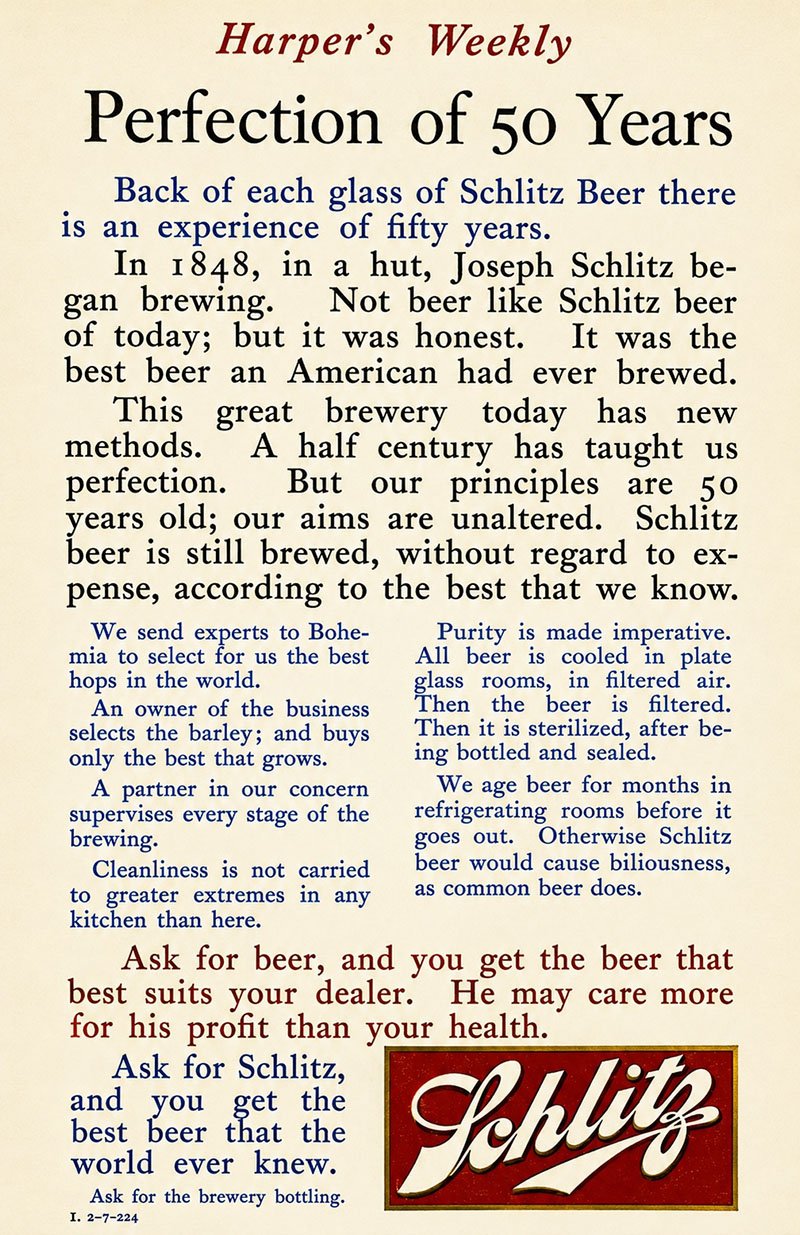
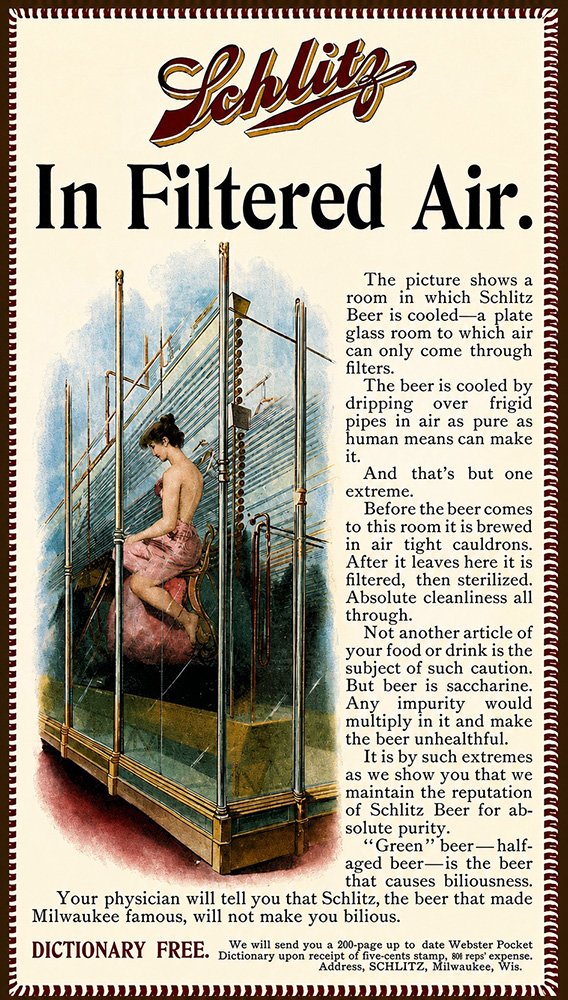
The ads below are from the series Claude Hopkins wrote that propelled Schlitz from dead last to first place in the beer wars of 1907. Instead of just saying Schlitz was pure, he detailed the process. The market understood it and responded.
Everyone else simply claimed their beer was “pure.” Hopkins provided evidence to prove Schlitz' purity.
I’ve also included an ad for Rolls-Royce written by the great David Ogilvy from 1959.
You may be thinking, well, these are old ads and things are different now. Yes, they’re old, and no, things are not different now. That’s because people haven’t changed and neither has the psychology of selling.
Other than media, there’s nothing new in marketing, so understanding the lessons of the past is critical. To ignore them is to waste effort, time, and money.
Look for modern examples of proof-based marketing and you’ll find them everywhere.
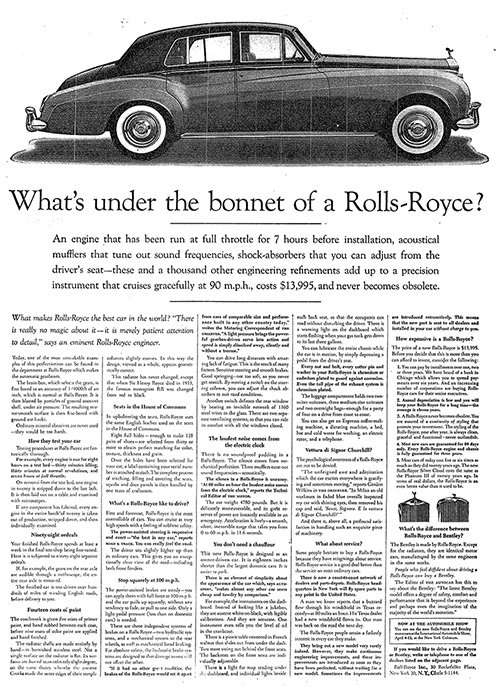
This ad is about what makes a Rolls-Royce a Rolls-Royce. It’s the details that convince the car buyer that Rolls-Royce is the pinnacle of car ownership and excellence.
Now, the prevailing “wisdom” is that no one reads long copy, and in inconsequential matters, that’s true. Who wants to devote 10 minutes to read about the compelling properties of masking tape?
BUT if a person is researching a product or service that deeply impacts their lives, like Senior Living, they’ll read long copy.
(The ad would have been hard to read in its original form, so I provided the copy in a readable format.)
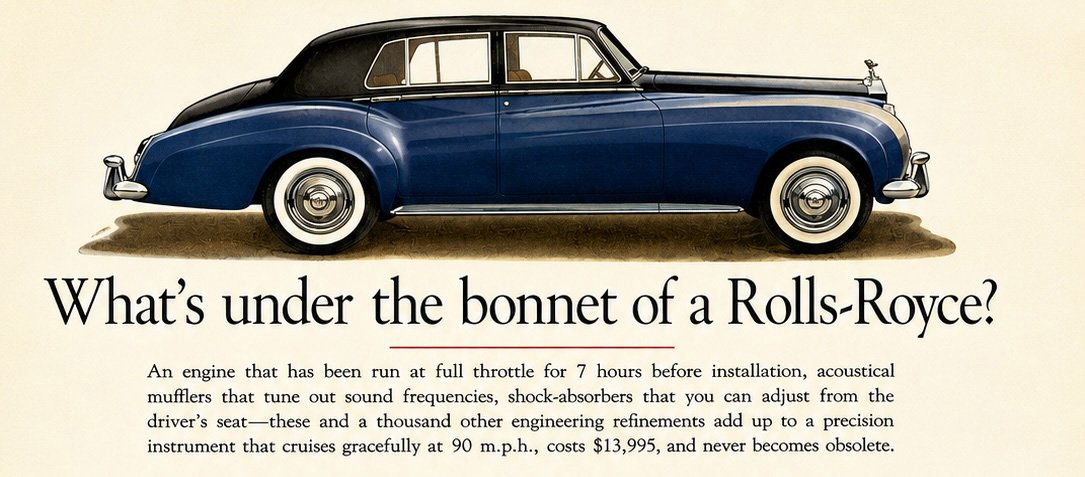
What makes Rolls-Royce the best car in the world? “There is really no magic about it–it is merely patient attention to detail,” says an eminent Rolls-Royce engineer.
Today, one of the most remarkable examples of his perfectionism can be found in the department at Rolls-Royce which makes the automatic gearboxes.
The brain-box, which selects the gears, is first bored to an accuracy of 1/4000th of an inch, which is normal at Rolls-Royce. It is then blasted particles of ground coconut shell, under air pressure. The resulting mirror-smooth surface is then fine-bored with ground oat-husks. Ordinary mineral abrasives are never used–they would be too harsh.
How they test your car
Testing procedure at Rolls-Royce are fantastically thorough.
For example, every engine is run for eight full hours on a test bed before it is placed in a car–thirty minutes idling, thirty minutes at normal revolutions, and seven hours at full throttle.
On removal from the test bed, one engine in twenty is stripped down to the last bolt, laid out on a table and examined with microscopes.
If any component has faltered, every engine in the entire batch of twenty is taken out of production, stripped down, and then individually examined.
Ninety-eight ordeals
Your finished Rolls-Royce spends a week in the final test-shop, being fine-tuned. Here it is subjected to ninety-eight separate ordeals.
If, for example, the gears on the rear axle are audible though a stethoscope, the axle is removed.
The finished car is test-driven over hundreds of miles of winding English roads, before delivery to you.
Because of these exacting testings, you do not have to go through the tiresome ordeal of “breaking-in” your Rolls-Royce.
Fourteen coats of paint
The coachwork is first given five coats of primer paint, and hand rubbed between each coat, before nine coats of color paint go on.
The radiator shells are made entirely by hand–in burnished stainless steel. Not a single surface on the radiator is flat. Its surfaces are bowed to an infinitely slight degree, on the same theory whereby the ancient Greek made the outer edges of their temple columns slightly convex. In this way the design, viewed as a whole, appears geometrically correct.
This radiator has never changed, except that when Sir Henry Royce died in 1933s, the famous monogram RR was changed from red to black.
Seats in the House of Commons
In upholstering the seats, Rolls-Royce uses the same English leather used on the seats in the House of Commons.
Eight full hides — enough to make 128 pairs of shoes — are selected from thirty or more to obtain perfect matching for color, texture, thickness and grain.
Once the hides have been selected for your car, a label containing your serial number is attached to each. The complete process of stitching, filling and covering the seats, squabs and door panels is then handled by one team of craftsmen.
What’s a Rolls-Royce like to drive?
First and foremost, Rolls-Royce is the most controllable of cars. You can cruise at very high speeds with a feeling of sublime safety.
The power-assisted steering is responsive and exact — “the best in any car,” reports ROADS & TRACK. You can really feel the road.
The driver sits slightly higher up than in ordinary cars. This gives you exceptional clear view of the road — including both front fenders.
Stop Squarely at 100 m.p.h.
The power-assisted brakes are steady — you can apply them with full force at 100 m.p.h. and the car pulls up squarely, without any tendency to fade or pull to one side.
Only a very light pedal pressure (less than on domestic cars) is needed. There are three independent systems of power brakes on a Rolls-Royce — two hydraulic systems, and a mechanical system to the rear wheels, as well as mechanical hand braking. For absolute safety, the hydraulic brake systems are designed so that damage to one will not affect the other.
“If it had no other great qualities,” writes the Motoring Correspondent of THE OBSERVER, “the brakes of the Rolls-Royce would set it apart from cars of comparable sizes and performance built in any other country today. A light pressure brings the powerful gearbox-driven servo into action and speed is simply dissolved away, silently and without a tremor.”
The loudest noise comes from the electric clock
There is no soundproof padding in a Rolls-Royce. The quiet comes from mechanical perfection. Three mufflers tune out sound frequencies — acoustically.
The silence in a Rolls-Royce is uncanny. “At 60 miles an hour the loudest noise comes from the electric clock,” reports the Technical Editor of THE MOTOR*.
The car weighs 4780 pounds. But it is delicately maneuverable, and its great reserve of power are instantly available in an emergency.
Acceleration is lively — a smooth, silent, inexorable surge that takes you from 0 to 60 m.p.h. in 11.6 seconds.
*When one of the senior Rolls-Royce engineers read this, his comment was, “We really must do something about that clock.”
You don’t need a chauffeur
This new Rolls-Royce is designed as an owner-driven car. It is eighteen inches shorter than the largest domestic cars. It is easier to park.
You can drive long distances with amazing lack of fatigue This is a result of many factors. Sensitive steering and smooth brakes. Good springing — not too soft, so you never get seasick. By moving a switch on the steering column, you can adjust the shock-absorbers to suit road conditions.
Another switch defrosts the rear window by heating an invisible network of 1360 steel wires in the glass. There are two separate ventilating systems, so that you can ride in comfort with all the windows closed.
There is an element of simplicity about the appearance of the car which, says AUTOSPORT, “makes almost any other car seem cheap and tawdry by comparison.” For example, the instruments on the dashboard. Instead of looking like a jukebox, they are austere white-on-black, with legible calibrations. And they are accurate. One instrument even tells you the level of oil in the crankcase.
Picnic tables–standard equipment
A picnic table veneered in French walnut slides out from under the dash on your Rolls-Royce. Two more swing out behind the front seats. The backrests on the front seats are individually adjustable.
There is a light for map reading under the dashboard, and individual lights beside each back seat, so that the occupants can read without disturbing the driver.
You can lubricate the entire chassis while the car is in motion, by depressing a pedal from the driver’s seat.
There is a warning light on the dashboard which starts flashing when you gas tank gets down to its last three gallons.
Every nut and bolt, every cotter pin and washer in your Rolls-Royce is chromium or cadmium plated to guard against corrosion. Even the tail pipe of the exhaust system is chromium plated.
The luggage compartment holds two two-suiter suitcases, three medium-size suitcases and two overnight bags–enough for a party of four on a drive from coast to coast.
You can also get an Espresso coffee-making machine, a dictating machine, a bed, hot and cold water for washing, and an electric razor, and a telephone.
Vettura di Signor Churchill?
The psychological overtones of a Rolls-Royce are not to be denied.
Reports Gordon Wilkins in THE OBSERVER: “The unfeigned awe and admiration which the car excites everywhere is gratifying and sometimes moving. In Milan an old workman in faded blue overalls inspected my car with shining eyes, then removed his cap and said, ‘Scusi, Signore. E la vettura di Signor Churchill?’ ”
And there is, above all, a profound satisfaction in handling such an exquisite piece of machinery.
What about service?
Some people hesitate to buy a Rolls-Royce because they have misgivings about service. Rolls-Royce service is a good deal better than the service on most ordinary cars. There is now a coast-to-coast network of Rolls-Royce dealers and parts-depots. Rolls-Royce headquarters in New York will fly spare parts to any point in the United States.
A man we know reports that a large buzzard flew through his windshield in Texas recently–at 80 mile an hour. His Texas dealer had a new windshield flown in. Our man was back on the road the next day.
The Rolls-Royce people retain a fatherly interest in every car they make.
They bring out a new model very rarely indeed. However, they make continuous engineering improvement, and these improvements are introduced as soon as they have been perfected, without waiting for a new model.
Sometimes the improvements introduced retroactively.
This means that the new part is sent to all dealers and installed in your car without charge to you.
How expensive is a Rolls-Royce?
The price of a new Rolls-Royce is $13,995. Before you decide that this is more than you can afford to invest, consider the following arithmetic:
- You can pay by instalments over one, two or three years. We have heard of a bank in Chicago which allows you to spread payments over six years. And an increasing number of corporations are buying Rolls-Royce cars for their senior executives.
- Annual depreciation is low and you will keep your Rolls-Royce for a long time–the average is eleven years.
- A Rolls-Royce never becomes obsolete. You are assured of a continuity of stylingthat protects your investment. The styling of the Rolls-Royce, year after year, is always clean, graceful and functional–never outlandish.
- Most new cars are guaranteed for 90 days only. Every Rolls-Royce engine and chassis is guaranteed for three years. This is important.
- Most cars of today cost five or six times as much as they did twenty years ago. The new Rolls-Royce Silver Cloud costs the same as Phantom III of twenty years ago. In terms of real dollars, the Rolls-Royce is an even better value than it used to be.
What’s the difference between Rolls-Royce and Bentley?
The Bentley is made by Rolls-Royce. Except for the radiators, they are identical motor cars, manufactured by the same engineers in the same works.
People who feel diffident about driving a Rolls-Royce can buy a Bentley.
The Editor of THE AUTOCAR has this to say about the Bentley: “The latest Bentley model offers a degree of safety, comfort and performance that is beyond the experience and perhaps even the imagination of the majority of the world’s motorists.”
If you would like the rewarding experience of driving a Rolls-Royce or Bentley, write or telephone to one of the dealers listed on the next page.
Rolls-Royce Inc., 10 Rockefeller Plaza, New York 20. Circle 5–1144.