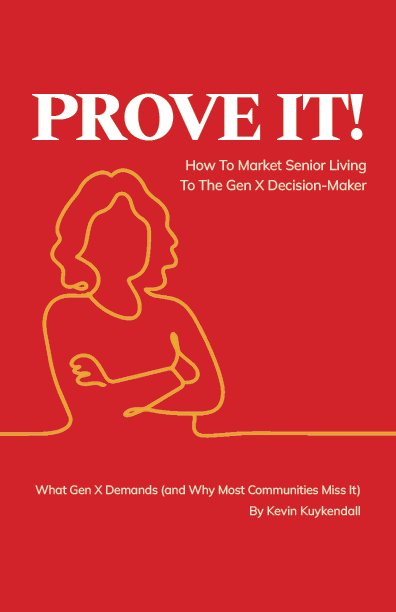
The PROVE IT! manuscript was completed May 13th, 2026, so details about the small implementation groups are not hammered out yet.
Email me if you want to discuss implementing PROVE IT!
Table of Contents
Preface
Part One: The Buyer Who Changed
- Chapter 1 — How Boomers Made This Decision (And Why It Worked)
- Chapter 2 — Meet the New Decision-Maker
Part Two: How Trust Is Built
- Chapter 3 — The Shift: From Inside-Out to Outside-In
- Chapter 4 — What the Trust Path Is and Why It Has to Be Built
- Chapter 5 — The Seven Layers of the Trust Path
- Chapter 6 — The Gen X Trust Fund
Part Three: What She Needs to See
- Chapter 7 — Priority One: Care
- Chapter 8 — Priority Two: Safety and Security
- Chapter 9 — Priority Three: Quality of Life
Part Four: Turning Her Research Into Your Position
- Chapter 10 — Teaching Them How to Evaluate Everyone, Including You
Part Five: After She Trusts You
- Chapter 11 — The Gap: Trust Without a Contract
- Chapter 12 — After Move-In: The Trust Path Doesn't End
Part Six: Build It, Run It, Sustain It
- Chapter 13 — Building Your Trust Path Architecture
- Chapter 14 — AI as Your Trust Path Production Engine
Conclusion: The Community That Wins
Appendices
- Appendix A — Trust Fund Audit Worksheet
- Appendix B — Trust Path Production Tracker
- Appendix C — The Proof Packet Template
- Appendix D — Discovery Guide Template
- Appendix G — State Compliance Research Guide
Chapter 1: How Boomers Made This Decision (And Why It Worked)
The marketing playbook that built this industry was not wrong.
It was exactly right for the buyer it was built for. That buyer has changed.
Before you can understand what Gen X needs from you now, you need to understand what Boomers needed then, and why delivering it was so much simpler. The contrast isn't history. It's the lesson.
The World Boomers Grew Up In
Boomers extended trust to institutions. That wasn't naïve. It was learned behavior, earned over a lifetime of systems that actually delivered.
Their childhoods were shaped by the post-war expansion of American hospitals, churches, corporations, and government programs that worked. They grew up witnessing the proof of those institutions. The trust wasn't blind; it was built on evidence accumulated across decades of ordinary life.
That posture carried forward. When a Boomer evaluated a senior living community, the default was openness. "Show me what you have" was a genuine invitation, not a test.
That is the first difference. And it changes everything downstream.
The Pain Point Was the Nursing Home
Senior living marketing in the Boomer era was organized around a single, powerful contrast: we are not the nursing home.
Institutional care was sterile, clinical, and depersonalizing. Families knew it. They feared it. The hospitality model with its beautiful dining rooms, activity calendars, warm residential spaces that didn't look like a ward, were the direct relief from that fear.
The message was straightforward: your mother will live here, not recover here. It landed because it solved the exact problem Boomer buyers carried into the conversation.
That contrast was real. The marketing built on it was effective.
Inside-Out Marketing: "Here's What We Have"
The Boomer model was built inside-out. The community was the subject. The community decided what to show, what to emphasize, how to frame itself. The prospect was the audience.
"Here's our beautiful dining room. Here's our activity calendar. Here's our caring staff." The Boomer buyer looked at that presentation and said: I trust this. I can see my mother here.
That sequence worked because it required something the Boomer buyer was willing to give: trust extended before evidence is examined.
The primary marketing asset was the brochure — printed, polished, built to impress. The central sales skill was personal connection, delivering the emotional promise of relief from guilt and from the clinical alternative. Warmth, aesthetics, and a skilled relationship-builder were often enough to move the decision forward.
It worked. For years, it worked.
Why It Has a Sell-By Date
The Boomer buyer has aged out of the decision-maker role.
The adult child researching communities for a parent today is Gen X. She doesn't extend trust. She tests for it. And she arrived at this decision already skeptical — not because any specific community gave her reason, but because 40 years of formative experience taught her that institutions say one thing and do another. She is not going to set that conditioning aside because your homepage has warm photography and a tagline about compassionate care.
The beautiful brochure doesn't impress her. It makes her ask what you're not showing.
The warm sales counselor doesn't reassure her. It makes her wonder when the pitch starts.
The lifestyle photography of happy residents in a sunlit dining room doesn't answer the question she actually carries: what happens to my father on a Tuesday night when something goes wrong and I'm three states away?
The Boomer model assumed trust. The Gen X model demands proof
That's not a messaging problem. It isn't a design problem. It isn't a matter of refreshing the website copy or swapping in newer photography. It is a fundamental shift in who is making the decision and what they require to make it.
The rest of this book is built around that difference.
NOTE: Each chapter in this book concludes with an AI prompt written to accomplish a specific task related to the chapter topic. Even though a certain level of AI skill is assumed, the prompts are simple and basic.
AI Application
What this prompt produces: An audit of your existing marketing materials against the Boomer model, identifying language, imagery, and messaging that signals inside-out thinking.
Required inputs:
- Community name and care types offered
- Website URL
- Sample brochure or marketing copy (pasted as text or uploaded)
The prompt:
You are a senior living marketing strategist. Review the following marketing materials from [COMMUNITY NAME], a [CARE TYPES] community.
Identify every element — including language, claims, imagery descriptions, and structural choices — that reflects inside-out marketing. Inside-out marketing presents the community as the subject, leads with what the community has or offers, and asks the prospect to trust the presentation before examining evidence.
For each element you identify, note: (1) the specific phrase, claim, or structural choice; (2) why it signals inside-out thinking; and (3) whether it is likely to build trust or trigger skepticism in a
Gen X adult-child decision-maker.
Do not suggest replacements yet. The goal of this audit is to see the current materials clearly.
Materials to review: [PASTE MATERIALS HERE]
What to do with the output: Use the audit as a baseline before Chapter 3's inside-out to outside-in rewrite process. Share it with your marketing team. The items flagged are not failures. They are the Boomer-era tools that served you well. They need to be replaced with tools built for the buyer who replaced her.